MVP Is Not a Product. It’s a Learning System
Updated: Mar 23
Most founders misunderstand MVP.
They think it means “build a smaller version of the product.”So they spend months designing features, polishing UX, and writing code.
Then they launch. And nothing happens.
The problem is not execution.The problem is misunderstanding what MVP actually is.

MVP Was Never About the Product
Over time, MVP has been defined in many ways.
Some call it a “minimal product.” Others describe it as a version built for early adopters. Some see it as a prototype or even a communication tool.
But all of these definitions miss the core idea.
MVP is not about building a product. It is about learning as fast as possible with minimum resources
The product is just a tool.The real goal is validated insight.
The Real Purpose of MVP
An MVP exists to answer one question:
“Are we building something people actually want?”
More specifically, it helps test critical assumptions:
Do customers care?
Will they pay?
Does this feature matter?
Can we acquire users efficiently?
If your MVP does not answer these questions, it is not an MVP. It is just a smaller product.
The 3 Elements Every MVP Must Have
A real MVP is not defined by how “small” it is. It is defined by whether it creates a learning loop.
Every MVP must include three elements:
1. Representation (Art)
How you present your idea.
This could be:
a conversation
a mockup
a video
a landing page
or a working app
2. Distribution
How users actually see it.
This is where most founders fail.
If no one sees your MVP, there is no learning.
3. Feedback Mechanism
How you collect real signals.
Not opinions. Not compliments. Behavior.
signups
clicks
purchases
usage
Without these three, it is not an MVP
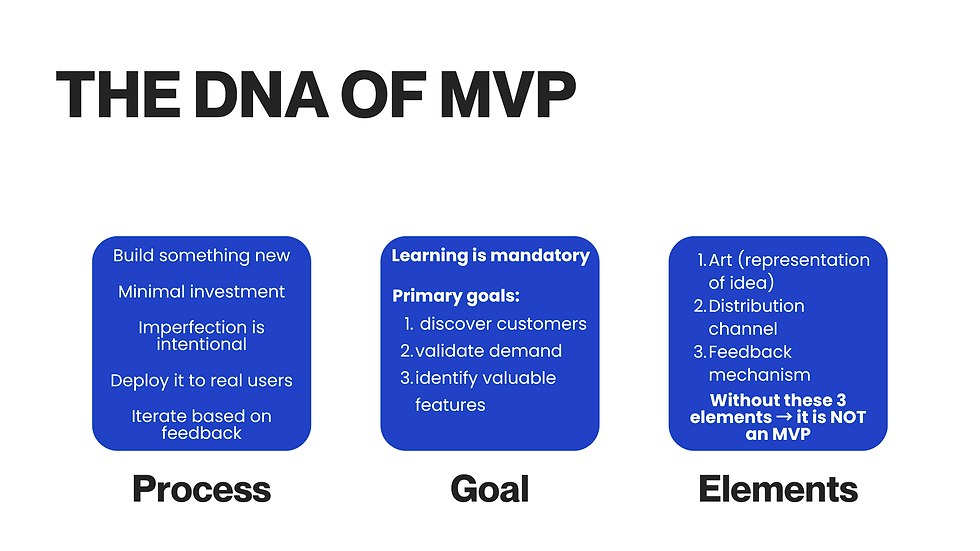
MVP Is a System, Not a Stage
Most founders think MVP is a single step before product.
It is not.
It is a continuous system:
Discover customers
Validate demand
Identify valuable features
Iterate
The loop never stops.
MVP is not something you “finish.”It is something you operate.
Not All MVPs Look the Same
There is no single MVP format.
In fact, the smartest founders use different levels of fidelity depending on what they need to learn.
Low-Fidelity MVP
Format: conversation
Cost: zero
Learning: high
Mid-Fidelity MVP
Format: landing page or demo
Cost: low
Learning: very high
High-Fidelity MVP
Format: working product
Cost: higher
Learning: highest
The mistake is jumping too early to the last one.
You don’t need code to learn. You need exposure to real users.

MVP Is Modular
Think of MVP like Lego blocks.
You combine:
different representations
different channels
different feedback loops
Example:
simple version → talk to users + verbal feedback
advanced version → app + app store + real purchases
There is no fixed path. Only faster or slower learning.
Where Founders Go Wrong
Most MVPs fail not because of bad ideas, but because of bad execution.
Common mistakes:
building too much
building too perfect
building without distribution
building without feedback
building for ego, not learning
The pattern is always the same:
Founders optimize for product. Instead of optimizing for learning.

Real MVPs Are Messy
The most successful startups did not start with polished products.
They started with imperfect tests:
simple websites
basic apps
explainer videos
manual operations
What they had in common was not quality. It was clarity of learning.

MVP = Uncertainty Reduction
At its core, MVP is a tool to reduce uncertainty.
Not to impress users. Not to scale. Not to build features.
Just to answer:
“Should we keep going?”
Every test should reduce one unknown.
market risk
demand risk
pricing risk
acquisition risk
If uncertainty is not decreasing, your MVP is not working.
What This Means for Founders
You don’t need a better product.
You need a better learning system.
Before writing code, ask:
What assumption am I testing?
How can I test it fastest?
What signal will prove or disprove it?
Because in early-stage startups:
Speed of learning beats quality of product.
How Founders & Partners Lab Thinks About MVP
At Founders & Partners Lab, we don’t evaluate startups based on how polished their product is.
We evaluate:
whether founders are testing the right assumptions
whether they are learning fast enough
whether their MVP actually proves something
Because investors don’t fund ideas.They fund validated learning trajectories.


Comments